Two agaves, two philosophies. Espadín is the cultivated workhorse behind most mezcal, while Tobalá is the rare, wild mountain agave prized by collectors and bartenders alike. Both shape Del Maguey’s single village range, yet they could hardly be more different. This guide compares espadín vs tobalá side by side, from botany and cultivation to flavor, scarcity and price, so you know exactly which one to pour first.
Espadín vs Tobalá at a Glance: Quick Comparison Table
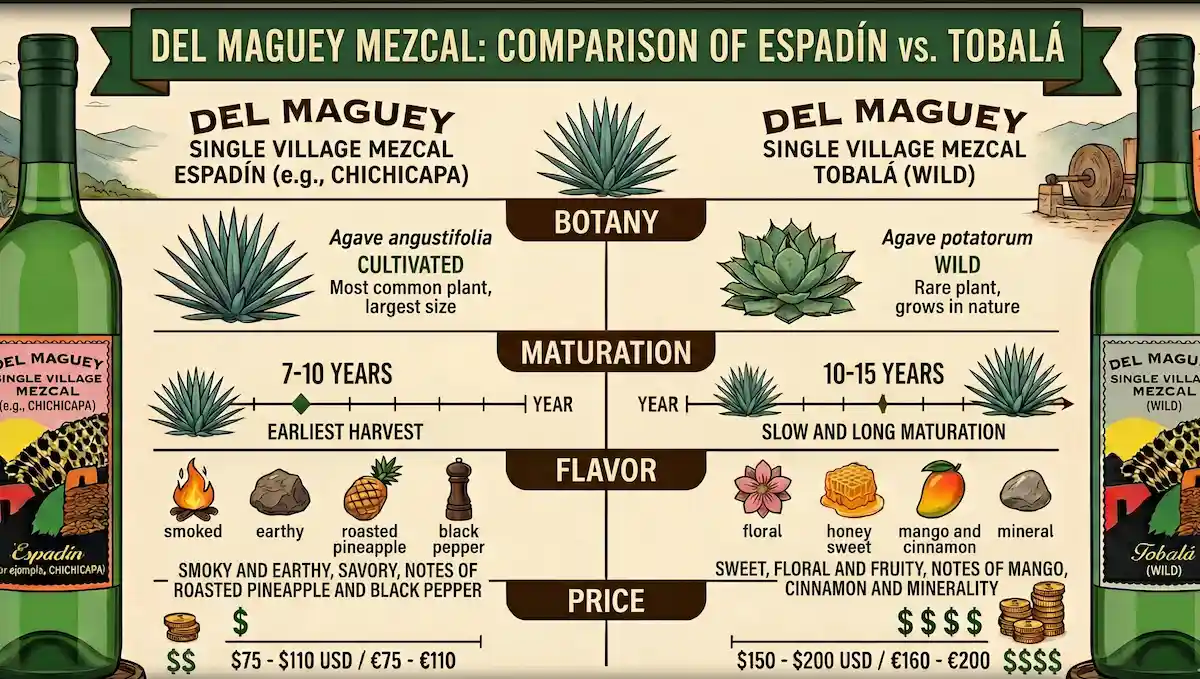
Before we dig into each agave, here is the short version. Espadín is abundant, affordable and reliably smoky, while Tobalá is scarce, expensive and delicately floral. The table below sums up the differences that matter most.
| Feature | Agave Espadín | Agave Tobalá |
| Botanical name | Agave angustifolia | Agave potatorum |
| Agave type | Cultivated, farm grown | Wild or semi cultivated |
| Where it grows | Planted across Oaxaca | High altitude rocky, shaded slopes of Oaxaca and Puebla |
| Time to mature | 6 to 8 years | 10 to 15 years |
| Piña and yield | Large piñas, high sugar yield | Small basketball sized piñas, roughly 8 times more plants per bottle |
| Share of mezcal | 80 to 90 percent of production | A rare fraction of production |
| Flavor | Earthy, vegetal, smoky, citrus | Floral, fruity, sweet, mineral, smooth |
| Typical price | About 40 to 70 dollars | About 100 to 300 dollars or more |
| Del Maguey bottle | Vida (espadín) | Single Village Tobalá |
Agave Espadín (Angustifolia): The Cultivated Workhorse of Mezcal
Botanically known as Agave angustifolia, espadín is the most important agave in the category. It accounts for somewhere between 80 and 90 percent of all mezcal produced, which is why it is so often called the workhorse of mezcal. Its long, sword shaped leaves give it its name, espadín meaning little sword in Spanish.
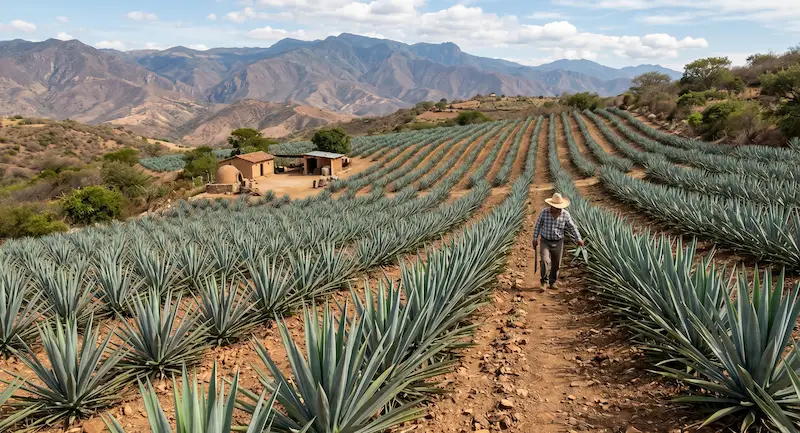
Espadín earns that reputation because it is straightforward to cultivate. Farmers plant it in rows and propagate it from the offshoots, or hijuelos, that grow around the mother plant. It reaches maturity in roughly 6 to 8 years and develops large piñas rich in sugar, which translates into a generous, consistent yield. The result is a mezcal that is smoky, vegetal and citrus tinged, versatile enough to sip neat or to anchor a cocktail.
For the full botanical profile, see our guide to agave espadín. Del Maguey Vida, the brand’s classic cocktail bottle, is distilled entirely from espadín.
That reliability is also why the modern mezcal boom was even possible. Because espadín can be planted, tended and harvested on a schedule, mezcaleros can produce in volume without stripping the hillsides of wild agave. Most of Del Maguey’s single village bottlings, from Chichicapa to San Luis del Rio, are built on espadín, with each village coaxing a slightly different character out of the same plant. In short, espadín is the canvas on which most of the category is painted.
Agave Tobalá (Potatorum): The Wild Mountain Agave
Tobalá, or Agave potatorum, sits at the opposite end of the spectrum. Often called the king of mezcal, it grows wild on high altitude, rocky and shaded slopes across Oaxaca and Puebla, rather than in cultivated fields. It is a small agave with broad, spade like leaves and a compact piña about the size of a basketball.
What makes tobalá special is also what makes it difficult. It does not readily produce offshoots, so it reproduces mainly by seed, with help from bats and other pollinators. That means it cannot simply be cloned and farmed at scale the way espadín is. Left to mature in the wild, it takes 10 to 15 years to be ready, and the mezcal it yields is floral, fruity and notably smooth, with mineral depth and only a whisper of smoke.
You can read more about this variety in our profile of agave tobalá.
The name tobalá is often linked to the idea of an agave that grows among the rocks, and you will frequently find it tucked into the shade beneath oak trees. For generations it was simply foraged, never planted, which is why it earned a near mythical status and why bottlings stayed in the hands of small villages long before mezcal went global. Tobalá is the best known wild agave, but it shares those mountains with even rarer relatives such as tepeztate, madrecuixe and jabalí, each one slower growing still.
Cultivated vs Wild: How Each Agave Grows and Matures
The clearest dividing line between the two is cultivation. Espadín is a cultivated agave: it is propagated from offshoots, planted deliberately and tended on agave farms, which keeps supply steady and predictable. Tobalá is a wild agave: it seeds itself on remote mountainsides and is gathered by hand, which is why it is often described as wild harvested or only semi cultivated.
Maturity widens the gap further. Espadín is ready in 6 to 8 years, while tobalá needs 10 to 15. Because every wild tobalá that is harvested has to be replaced by a slow growing seedling, responsible producers increasingly support sustainable harvesting and replanting to protect the species. That patience and care are part of what you taste, and part of what you pay for.
Pollination is the quiet hero of the story. Espadín is usually cut before it can flower, so it is propagated clonally and loses almost no time between generations. Tobalá depends on bats and insects to set seed, and that wild reproduction is exactly what preserves its genetic diversity, and its complexity. Protecting those pollinators and replanting harvested slopes are now central to keeping wild agave mezcal sustainable for the long term.
Flavor Profile Side by Side: Smoky-Vegetal vs Floral-Sweet
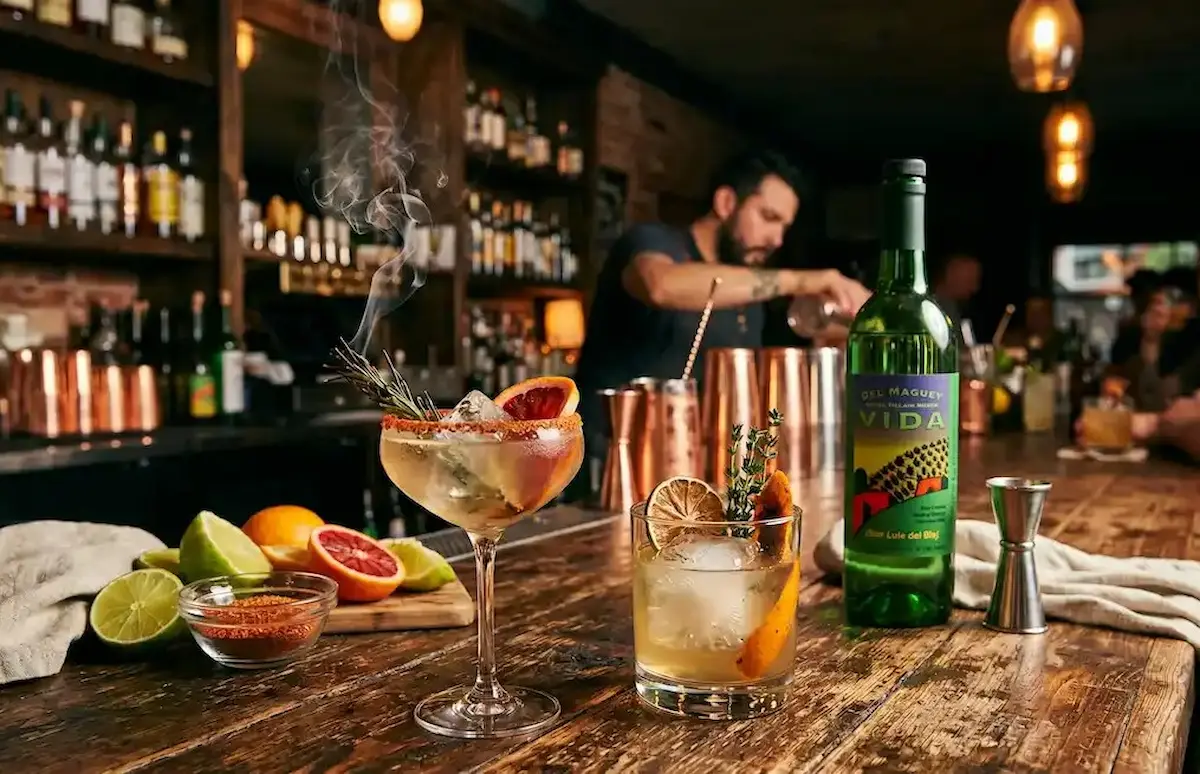
Espadín leans earthy and vegetal, with the classic campfire smoke that many people associate with mezcal and a bright citrus edge. It is bold and approachable, which is exactly why it works so well in cocktails.
Tobalá moves in a different direction. Expect delicate floral and tropical fruit notes, a rounded sweetness and a mineral, almost stony finish, with the smoke pulled right back. It rewards slow sipping and close attention, revealing layers that a mixer would only bury.
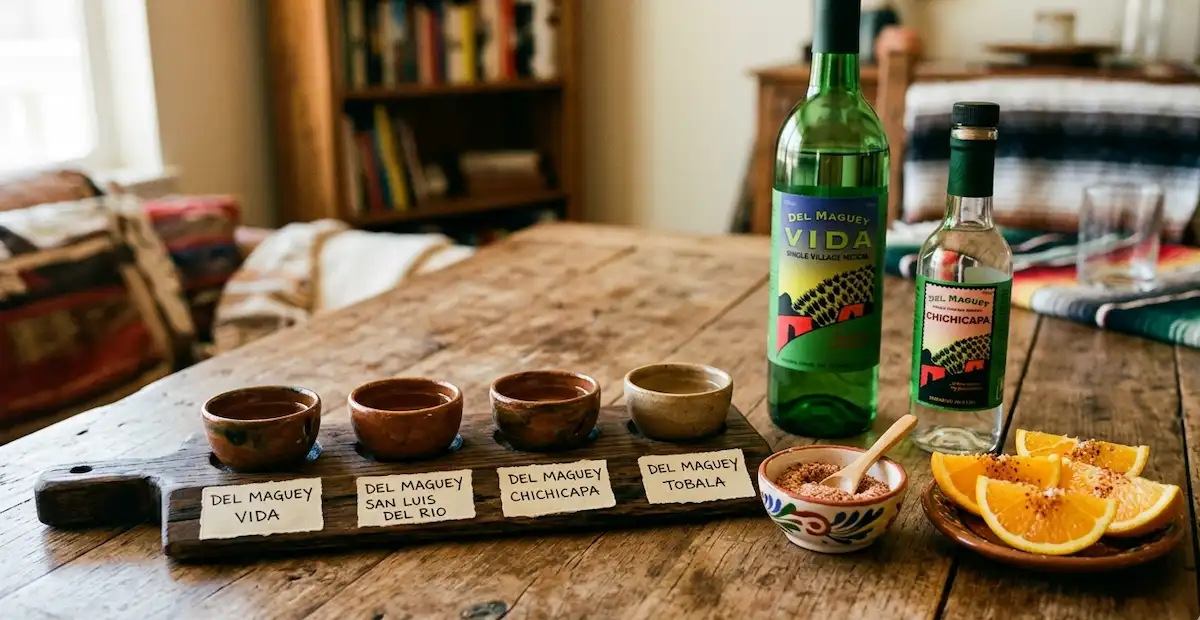
A practical way to feel the difference is to pour each into a copita. With espadín you meet smoke first, then green, herbal and citrus notes, and it happily takes a slice of orange and a little sal de gusano on the side. With tobalá the smoke steps aside almost entirely, letting ripe fruit, white flowers and clean minerality lead. One is a conversation starter, the other a slow read.
Why Tobalá Costs More: Scarcity, Yield and Maturity
The price gap is not marketing, it is arithmetic. Tobalá piñas are small, so it takes roughly 8 times more plants to make the same volume of mezcal as espadín. Add a 10 to 15 year wait, the labor of climbing remote slopes to harvest by hand, and the fact that the plant resists large scale farming, and scarcity is built in.
That is why an espadín bottle typically lands around 40 to 70 dollars, while a single village tobalá can run from 100 to well over 300. You are paying for time, terroir and rarity, not just liquid in a bottle.
Seen that way, the two are not really competitors, they are different occasions. Espadín is the bottle you reach for on a Friday night, pour into a round of cocktails or share without a second thought. Tobalá is the one you open for a milestone, decant slowly and talk about while you drink it. Understanding that is the key to spending wisely: buy espadín for volume and versatility, and save tobalá for the moments that deserve a rare, wild agave.
Try Them from Del Maguey: Vida (Espadín) and Single Village Tobalá
If you want to taste the contrast for yourself, start with Del Maguey Vida, an espadín from San Luis del Rio that is built for sipping and mixing. Then step up to Del Maguey Tobalá, a single village, wild agave mezcal meant to be savored slowly and neat.
Tasting them back to back is the fastest way to understand the difference between a cultivated and a wild agave, and it shows why Del Maguey’s single village approach, one village, one agave, one mezcalero, stands apart from industrial mezcal.
Espadín or Tobalá: Which Should You Try First?
If you are new to mezcal, begin with espadín. It is affordable, widely available and gives you the genre’s signature smoke, the perfect reference point and a natural fit for cocktails. Once that flavor feels familiar, reach for tobalá to experience how far a wild agave can travel, into floral, fruity and mineral territory that espadín never visits.
There is no wrong order, only two beautiful expressions of the same craft. Espadín is the dependable everyday companion, tobalá is the rare occasion. Together they show the full range of what artisanal, single village mezcal can be.