The worm in mezcal is the gusano de maguey, the larva of a moth that lives on the agave (maguey) plant. It is not found in every bottle, and it was never part of tequila. The larva was added to some mezcal bottles in the mid-20th century as a marketing idea, and today its absence is widely read as the sign of a serious, artisanal mezcal. Here is what the worm really is, how it ended up in the bottle, and why the finest mezcals leave it out.
What the Mezcal Worm Actually Is (the science)
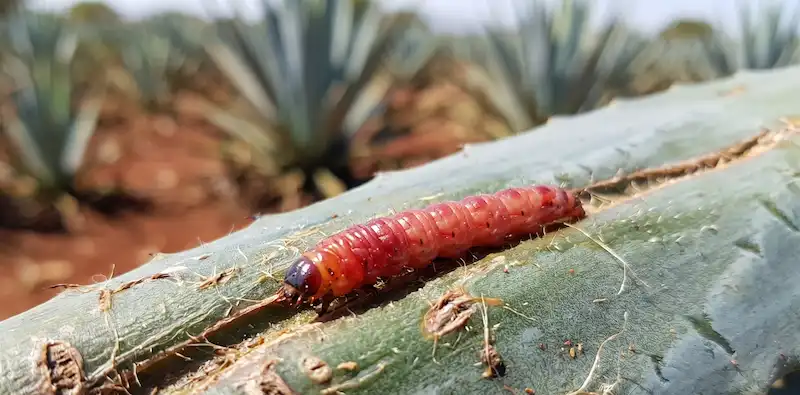
Despite the name, the mezcal worm is not a worm at all. It is an insect larva. A 2023 DNA study published in the journal PeerJ by researchers at the Florida Museum of Natural History analyzed larvae taken from mezcal bottles and found that essentially all of them belong to a single species: the agave redworm moth, Comadia redtenbacheri (family Cossidae), known in Mexico as the gusano rojo or chinicuil.
The larva spends its life feeding on the agave, the very plant mezcal is distilled from. So while it looks like a curiosity floating in a bottle, the worm is really part of the agave’s own ecosystem rather than something exotic added from outside.
The name is more a quirk of translation than of biology. In Mexico the larva is a gusano, which English flattened into worm, but it is really the caterpillar stage of a moth. It hatches on the agave, feeds inside the plant’s leaves and heart, and is gathered by hand. That shared origin is part of why it became tied to mezcal in the first place: the worm and the spirit come from the same plant.
Red Worm vs White Worm: one species, not many
You may have heard there are two different worms, a red one and a white one. The science tells a simpler story. Historically the names pointed to different insects, but the larvae actually found in commercial bottles overwhelmingly trace back to a single species. The 2023 study examined larvae from 21 bottles of mezcal, sourced both from distributors and from palenques in Oaxaca, and the DNA kept coming back to the same agave redworm moth.
The pale white worm you sometimes see is, in most cases, not a different creature at all. It is the same red larva that has lost its color after months or years steeping in alcohol. Folklore multiplied the worm into several mysterious species; the DNA collapsed it back into one.
Why Mezcal, and Never Tequila
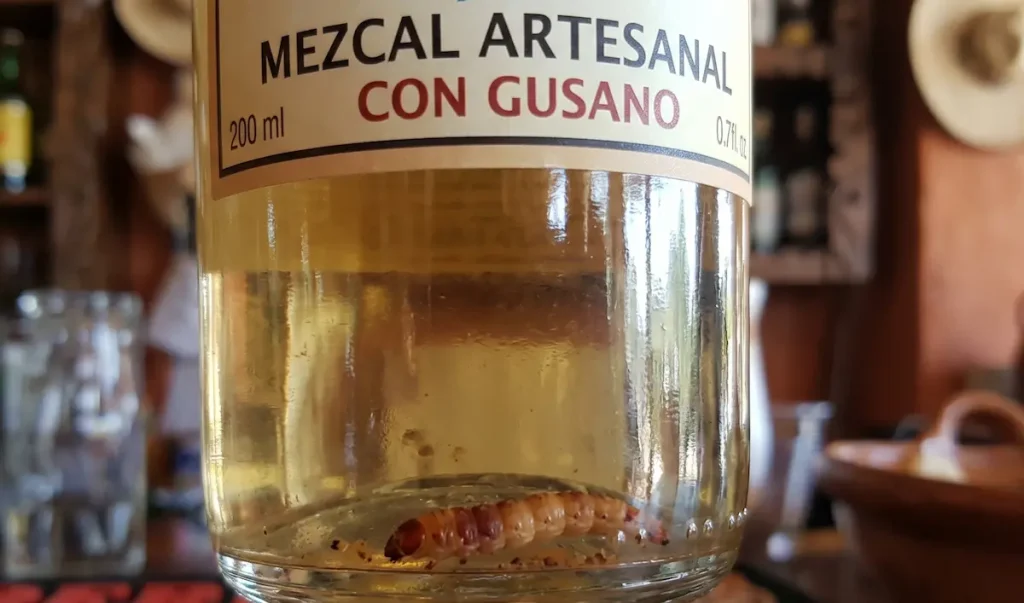
You will only ever find the larva in certain bottles of mezcal, never in tequila. The two spirits are governed by different Mexican standards. The tequila standard (NOM-006-SCFI-2012) allows only four mellowing ingredients, caramel color, oak extract, glycerin and sugar syrup, so a larva is simply not permitted; adding one would disqualify the spirit as tequila. The mezcal standard (NOM-070-SCFI-2016) is different. It recognizes a labeled category, Abocado con (Flavored with), that expressly includes the maguey worm among the ingredients a producer may add. That is the key: a bottle that genuinely contains the larva will say con gusano on the label. If it does not say so, it does not have one.
This is also why the popular phrase tequila worm is a misnomer. The worm was never part of tequila. It has always been a mezcal phenomenon, and a fairly recent one, which is exactly where the next part of the story comes in.
| Tequila | Mezcal | |
| Standard | NOM-006-SCFI-2012 | NOM-070-SCFI-2016 |
| Larva allowed? | No (only 4 abocado ingredients) | Yes, as the labeled class “con gusano” |
| Where the worm appears | Never | Only in bottles labeled “con gusano” |
| A sign of quality? | n/a | Its absence signals artisanal mezcal |
For the full picture of how the two spirits diverge, see our guide to the difference between mezcal and tequila.
A 20th-Century Marketing Idea, Not an Ancient Rite
The worm is often sold as ancient tradition, but it is a relatively recent commercial idea. It was popularized around the mid-20th century, in the 1940s and 50s, and is commonly credited to Jacobo Lozano Páez, who added it to give bottles a distinctive look for a growing export market. In other words, the worm was put there to be seen, not to be sipped. That also answers the question people ask most often: the point of the worm was marketing, not flavor or tradition.
Eating the Maguey Worm (and sal de gusano)
Yes, it is safe to eat. The larva is cured in the mezcal’s alcohol, so by the time it reaches your glass it has been preserved rather than left raw. Far from being a novelty, the maguey worm is a genuinely prized ingredient in Oaxacan cooking, where it is eaten roasted or ground with chiles and salt. That ground version is sal de gusano (worm salt), the rust-colored salt served alongside a good copita of mezcal, usually with a slice of orange. If you have ever been handed orange and a reddish salt with your mezcal, you have already met the worm in its most useful form.
The hallucinogenic myth
No, the mezcal worm is not hallucinogenic. It has no hallucinogenic properties, even after long soaking in alcohol, and it contains no mescaline or other psychoactive compounds. The idea is pure myth, probably born of the old confusion between mescal, the spirit, and mescaline, an unrelated cactus alkaloid.
Most Mezcal Today Is Bottled Without a Worm
Most mezcal today does not. The worm is now the exception rather than the rule, found mainly in lower-cost, export-oriented bottles. The simplest way to tell is the label: a bottle that contains the larva has to declare it as con gusano, because the Mexican rules require that flavoring class to be stated. Serious artisanal producers leave it out. If you pick up a bottle without a worm, that is not a sign something is missing. It is usually a sign the mezcal was made to be tasted on its own terms, where the agave, the village and the maker matter more than a novelty at the bottom of the glass.
Why Fine Single Village Mezcal Skips the Worm
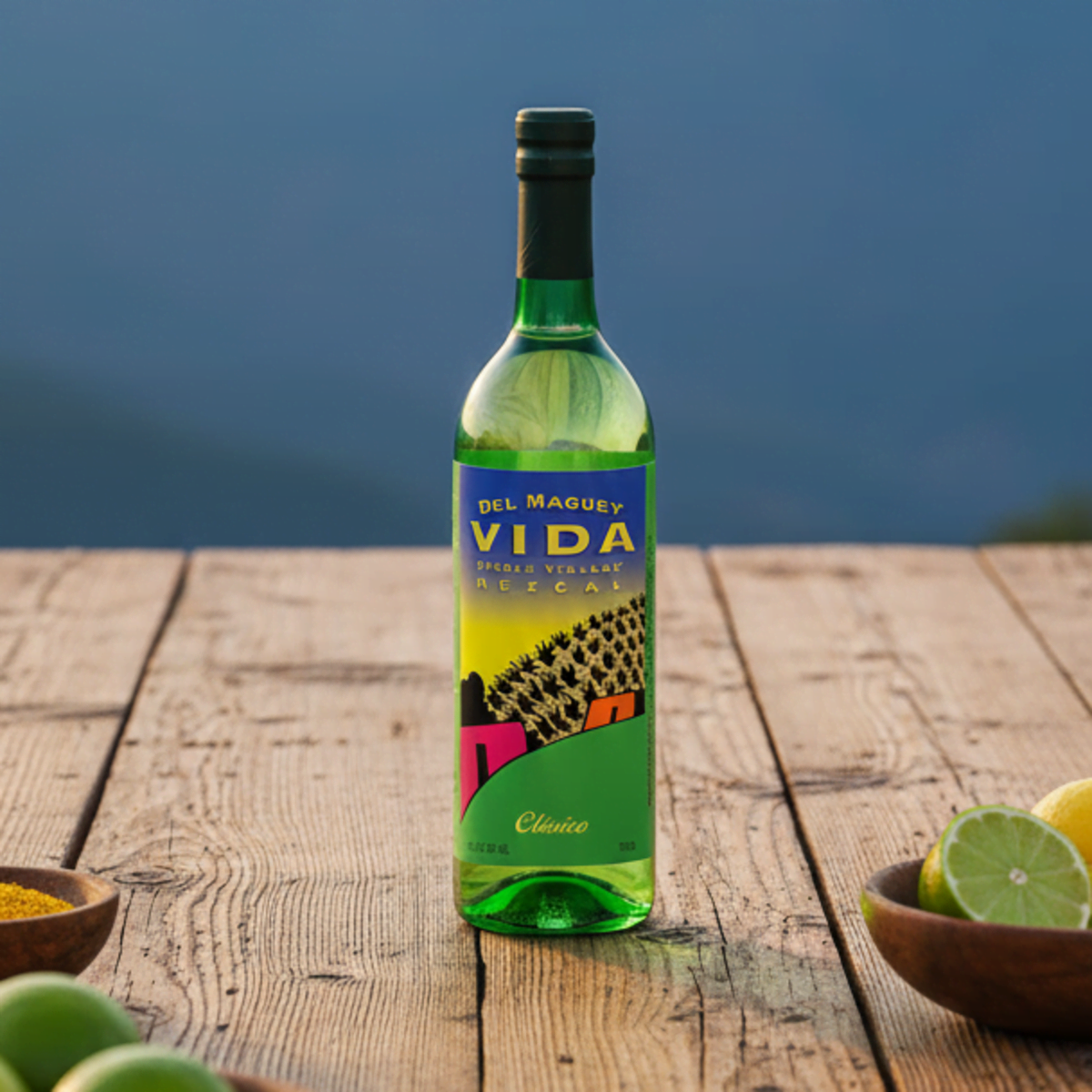
Among people who know mezcal, the worm is not a mark of quality. If anything, the opposite is true. The finest artisanal mezcals are bottled clean, with nothing in the glass but the spirit itself. Artisanal Single Village mezcal does not contain a worm. A bottle like Del Maguey Vida Clasico, distilled in copper in San Luis del Río from 100% espadín, is bottled with nothing added: that is what mezcal is supposed to taste like, without the gimmick. Sip it, don’t shoot it, and let the agave speak for itself.